
Another ongoing project "M" undertook throughout college (when he could have been studying useful subjects like Accounting) he dubbed "Monster of the Week." His fantasy world would be filled with strange inhabitants, and frightening creatures were likely to show up in horror and science fiction stories too, so he tried to outline some new Thing once a week. The "monster" might be something familiar from mythology or folklore (tweaked to fit his universe), a weird report out of cryptozoology or Forteana, or something totally made up.
Hey, nice work if you can get it! As I, Chester Monday, re-discover "M"'s inspirations and old college notes, I might just re-start "Monster of the Week!" Things we all know, like Yeti, things "M" came up with years ago, and even brand-new critters. The entries will have a brief description (nothing as specific as D&D stats, though – we’ll keep our options open and leave our monsters with a slight aura of mystery). Since we’re documenting the whole Fantasy World, we’ll show our sources (unless we made it up completely), and I’ll end with a comment if it seems necessary.
(A slight Update, March 2009: Life sure has changed since our carefree college days. It seems that every time we try to start a major project, Life, the Universe, and Everything toss some health, financial, or familial disaster at us. We kept to a Monster of the Week for a while as you can see below, but from now on we can only have the occasional Random Monster as we make time for it.)
The Random Monster, like the Fantasy World Project, began June 1, 2008, with:
This creature – if one can call it a creature – appears as a monstrous gray-green hand and arm that reaches out of the ocean to snatch people from piers, crush rowboats and drag ships to a halt. The Hand has cracked, blocky nails, barnacles pimpling its skin, and kelp and seaweed hanging from it in gloppy strings. The arm to which it is attached does not itself seem to be attached to anything. Glimpsed underwater, it stretches a mile into the depths. No one knows if it is a spirit, monster, or god, or part of one. The Hand might save drowning swimmers or pull a ship from the rocks, or it might kill and destroy. Its motives are as much a mystery as its origin and identity.
Comments: Well, I had to put it to “M”: Where did he come up with a Thing like that? His reply: “The Hand came from several directions, as most things do. Mainly I was looking for a new sort of sea monster one day, and I recalled that Cecil the Sea-Sick Sea Serpent started out as a hand puppet. Suppose someone had yanked the puppet off on live ‘50s TV? There’d be this huge hand and arm sticking out of the ocean near the Leakin’ Lena . . . I had various explanations for the Hand over the years, but I decided finally not to have it be a wizard’s creation or a manifestation of Poseidon or anything like that. It’s a total mystery in a mysterious world.”
This under-earth invertebrate resembles a monstrous sea urchin, ten feet in diameter, with numerous black tentacles instead of spines. The Cave Roller normally lives in subterranean lakes and rivers, but it can emerge into the open for short periods. It travels by rolling along in a sloppy, wobbly manner, and it senses the tiniest vibrations through its many tentacles. Spelunkers occasionally fall prey to Cave Rollers, and a catastrophe such as an earthquake or landslide can drive one into the upper world.
Comments: My man "M" says: "We took trips through Marvel Caves whenever we visited Silver Dollar City near Branson, Missouri. The guides always pointed to the cave roofs and told us of the ancient, swirling currents that carved them, millions of years ago. Then they'd switch off the lights for a moment to let us experience the ultimate darkness. Something had to be living in those endless tunnels!"
The beast might have been a dinosaur or a Komodo dragon or – George couldn’t say. If an alligator had legs like a bear and a shorter, doglike head, it might resemble this reptilian beast.
-- “The Ambrose Collectors”
The Snallygaster is a descendant of the prehistoric Protosuchus, ancestor of crocodiles and alligators. Its head is recognizably croc-like, but its jaws are short and rounded almost into a muzzle. It has much longer legs than the typical crocodilian, being an energetic land-dweller that can chase prey animals as fast as a dog or coyote. There are two species of this creature, one about the size of a black bear, which seems interested only in eating, and a smaller, very intelligent strain that acts more mischievous than hungry, often jumping out of hiding places or rolling down hills simply to frighten people.
Comments: “M” says “I like transitional creatures like the Archaeopteryx, half-lizard and half-bird, the Coelacanth, a fish well on its way to being a land animal, and the Protosuchus, a land reptile headed for ‘croc-hood’. The name Snallygaster actually refers to a dragonlike critter supposedly found in Maryland. It just seemed like the perfect name for a long-legged, fast-running, mischievous land ‘gator.”
Oh – and don’t worry about the quotes that come from stories you can’t quite place. Most of them haven’t been published yet. It’s all part of the expanding Fantasy World Project!
Its head was long, ears turned forward, one pricked and one folded forward. It had a peculiar barreled pig-like snout . . . It looked straight at Mr. Knowles, and this disturbed him, because he could not see any eyes – only a thin black line where the eyes should be. The torch was shone full into the strange face, but there was none of the usual retinal reflection familiar from animal eyes at night.
Bob Rickard, “The Exmoor Beast and Others”
Fortean Times No. 40 (Summer, 1983)
The Blind Beasts resemble aardvarks with extra-long legs: Thick, kangaroo-like tails, huge pointed ears, piglike snouts and hooflike claws. Their most striking feature, however, is their utter lack of eyes, a result of life deep within the earth. They are the ultimate trackers, their senses of smell and hearing being greater than even a dog’s or bear’s. Creatures and peoples who dwell underground or otherwise dislike the light of day raise the Blind Beasts as hunting animals.
Comments: M notes: “We’d better introduce these fairly early, as they appear in our initial Fantasy Novel. The Blind Beasts are analogous to the eyeless fish and shrimp found in certain cave systems, but the real spark came from the quoted Fortean report above (though, actually, Mr. Knowles’ sketch of the creature looks more like a Great Dane than an aardvark).”
This rare vulpine beast grows to be larger than most wolves, usually possessing fur of a black or gray color. Due to its odd appearance and fox-type antics (like balancing and hopping on its hind legs) it is often taken for a werewolf. The Giant Hill Fox is clever at covering its tracks, making it so difficult to follow it can be mistaken for an apparition. It dislikes the elaborate hunts formed in some countries to chase its smaller cousins and harries them from the shadows and woods. It is not known if it has powers like the famous Kitsune of the East, but it demonstrates near-human intelligence and cunning.
Sources: In an article in the British publication The Countryman, a woman named Vida Herbison writes of a strange encounter in Sussex. One morning as she and a friend named Mike rode their horses along part of an ancient Roman road, heading, ironically, toward a foxhunting meet, “the horses shied as a gigantic grey wolf-like creature came loping across the field on our offside.” It ignored the humans and horses completely as it crossed the track and vanished over a hill. Vida’s friend cried, “What the devil was that? Looked like a wolf, didn’t it? A werewolf.” They found no tracks, and inquiries as to possible owners, or animals escaping from circuses or zoos, were all negative.
In a later issue of The Countryman, a Doris W. Metcalf had this to say: “I too have come across wolf-like creatures in this part of Sussex, before the 1939-45 war. I always understood they were the last of an ancient line of hill foxes, though I have found them on the marshes too.” One of Metcalf’s sightings took place on a summer day near Jevington. As in the Herbison story, Ms. Metcalf was horseback riding with a companion when a large gray animal crossed the trail ahead of them, “taking not the slightest notice of us.” It loped down into a hollow and vanished. A second sighting took place during a foxhunt near Glenleigh Manor. It appeared on a lane in front of Metcalf and some companions only “a yard or two away.” When the humans stopped walking, it did as well, yet it otherwise didn’t acknowledge the people so close to it. It “seemed to listen to the sounds of the hunt before turning and loping off across the marshes towards Pevensey. Probably it was these big foxes that gave rise to many of the werewolf legends.”
Herbison, Vida. “Ghosts I Have Known,” in Countryman Vol. LIV, No. 4 (Winter 1957), pp. 633-636.
Metcalf, Doris W. “Werewolves in Sussex,” in Countryman Vol. LV, No. 2 (Summer 1958), p. 357.
Comments: Foxes as big as or bigger than wolves? The mind boggles. I always wondered if you really could “expand” small animals to make them giants. There might be physiological reasons against it. But in Sussex they apparently have super-sized vulpines! “M” says, “Even though we’re given only three ‘sightings’, there are common details that make them interesting: the creatures seem unafraid of humans, to the point of ignoring them completely even if they’re only a few feet away. Two were seen near foxhunts. Perhaps they had hunts of their own in mind . . .”
The Nittaewo are gibbonlike creatures found in tropical rain forests. They are covered with dark or reddish hair and, unlike apes, their fingers end in wicked claws. Their language is a “burbling” or bird-like twitter. They use no tools or weapons but catch small game or steal meat from human villages. They rip open their prey with their claws and devour the entrails, and they will so kill a lone human if they can catch one asleep. They build sleeping platforms in trees, roofed over with leaves; beyond this they possess no trappings of civilization.
The Nittaewo stand only a meter or so high, but they travel in groups, so they can be quite dangerous to travelers. Different human tribes will often band together to wipe out populations of these hairy beings if they take to harassing villages.
Heuvelmans, Bernard (Trans. Richard Garnett). On the Track of Unknown Animals (London: Kegan Paul, 1995 [1955]).
Comments: On this earth the Nittaewo supposedly inhabited Ceylon, and they were continually at war with a tribe called the Veddahs. The Veddahs finally chased the last of the creatures into a cave and built a huge fire at the entrance, keeping it burning for three days, until all the Nittaewo smothered. Judging by the ages of the native informants, this extermination occurred around the year 1800. Most of our information comes from a British explorer named Hugh Nevill, but other hunters and explorers collected stories of the Nittaewo. If the accounts are true, it is a unique example of an inter-species war in relatively recent times.
“M” says: “Heuvelmans’ books were major influences on the Fantasy World. I’d heard about them since I was a kid in grade school, but I never came across them until I entered Oklahoma State University. Strangely, we have to read 100 pages into Heuvelmans before coming across our first “monster”, the Nittaewo. I’m acting almost as if I’ve never read anything about myth, legend, and folklore before, so I’m presenting creatures as I “discover” them. A haphazard way to do it, but we ought to have quite a variety before we’re done!
This creature resembles a large, flightless bird, like an ostrich. However, it has a scaly skin and a long, balancing tail. It can run as fast as or faster than a man, but it normally frequents ponds and watering holes. It can duck beneath the water for minutes at a time, attacking and drowning prey as large as or larger than itself.
Comments: The Australian Aborigines speak of the amphibious Gauarge. It dwells in watering holes and drags down anyone who bathes there. "It looks like an emu, but without feathers," writes Bernard Heuvelmans.
Heuvelmans points out that this description would fit the Struthiomimus, a slender, bidedal, Cretaceous dinosaur with a birdlike beak. (The Jurassic Park critter "Gallimimus" is a related animal.) Perhaps, trapped on the Australian island-continent, these Ornithomimosaurs ("bird-mimicking reptiles") took to a semi-aquatic life and survive to this day Down Under. (On the Track of Unknown Animals pp. 228-230.
I had never before seen a Garith, but there was no mistaking this beast’s identity. Something like a very fat mongoose, something like a very narrow badger, with blue fur and antennae that sparkled like dew on spider silk. If those qualities didn’t set Garithi apart from other creatures, their powers of mind-moving and -speaking certainly did.
-- The Lykoniad
Garithi represent a group of mammals that evolved in the early Jurassic era, either on a parallel world or on the lost Pacifica continent of Earth. Whereas the proto-mammals of Earth remained unchanged for millions of years due to the overwhelming presence of dinosaurs, the Garithine mammals thrived and evolved in seclusion. These mammals tended toward blue or white hair color, and most of them possessed psi-focusing antennae on their foreheads.
Modern-day Garithi, as mentioned, resemble a cross between a mongoose and a badger. Gold-colored, lyre-shaped antennae sprout just above their eyes, which literally glow when they exercise their psychic powers. Garithi fur comes in shades of gray, blue, and white, though the stripings and shadings vary from individual to individual.
Garithi can move up to 40 pounds using telekinesis. They can communicate easily via telepathy, connecting several minds at once. They are intelligent but childlike; they can be pests, but they are easily befriended. They make valuable companions in the wild, but they are still animals and will flee strange creatures or phenomena.
Comments: This little critter has been called “cute”, but don’t get it riled! “M” says: “The Garithi are part Rikki-Tikki-Tavi, part Gef the Talking Mongoose, and part that otter-thingy in the animated series Jann of the Jungle. The thought of a small, innocuous animal with powerful psychic abilities amused me. Fortunately, they are friendly for the most part towards humans. In fact, many a traveler or explorer has owed his or her life to Garithi.
“The idea of mammals evolving a hundred million years early was a vague idea I always kicked around. Maybe more blue furred mammals with weird powers will appear in the future.”
Its emaciated body resembled a human's, but its head was that of a dog or wolf. Though not truly furred, cobweb-wisps of hair covered its torso and limbs, and a horselike mane bunched on its head and neck. No lips hid its jagged teeth, and no lids shaded its fiery eyes . . . It bent double, skinny arms thrown wide; its clawed fingers were like hawk talons. Vertebrae bulged through its paper-thin skin like knuckles, and it whipped a naked rat-tail to and fro . . . I seized its upper arm in my teeth; whatever ran through its veins tasted acrid and sour.
-- “The Fox-Maid”
The name Crucota meant in medieval times a sort of demonic hyena, or a hyena-lion cross-breed. More from “The Fox-Maid”: “The monster’s mane and hideous laugh reminded me of a hyena,” as did its ghoulish appetite. The creature is a cross between a werewolf and a ghoul; possibly a lycanthrope infected with “ghoulishness” rises after death as a Crucota. It fears weapons made of cold iron rather than silver; it regenerates quickly from non-iron-inflicted injuries. There is a distinct anesthetic quality to its saliva, its blood, and even its scent; the tongue of an animal that bites it will go numb, as will a limb bitten by the creature, and its smell is almost like a void in the air rather than an odor.
Comments: “M” says: “This will also be appearing in our novel, though I’ve used it elsewhere, as you can see. A minor influence on this undead creature was a cheap movie called The Monster Club, an anthology film about monster ‘cross-breeds’ with ridiculous names -- a ‘Vamp-Goo’ was half vampire and half ghoul, a “Hume-Goo” was half human and half ghoul, etc. I decided I could come up with better, and more logical, cross-breeds. Thus the half werewolf, half ghoul Crucota.”
Shoulders and thighs slid under a thick pelt, and four stocky legs carried into view a huge rectangle of a body, like a freight car with paws. A great round head hung low to the earth, as if too heavy for the neck, rhino-thick though that was. A golden eye focused, saucer-ears folded back, and the broad muzzle of an immense lionlike beast swept around to face me . . . A pink slobbering tongue, hefty as a boxing glove, draped down between two stalactite-fangs. The tongue quivered and jerked and slapped up to lick wrinkled feline chops.
-- The Gray Messiah
The Smilodon is, of course, an actual creature of terrestrial prehistory, being a huge feline with nine-inch fangs and a jaw that could open nearly 180 degrees to use them. Many species extinct on earth still exist in Sakria. There were other species of sabre-tooths, but the Smilodon, which lived in North and South America as recently as 20,000 years ago, is the most famous.
Comments: “M” says: Sabre-tooth tigers are just cool! If I ever create a straight lost world/prehistoric series, I’ll have to have them, but the Fantasy World Project feels very archaic in some areas, and Ice Age animals don’t seem out of place here.
Chester: This opens up a door to any prehistoric creatures you might want.
M: Some will be more “logical” than even the Long-Tooth, as we will see both here and in the main Project articles.
C: Sabre-tooths, blue otter-things, a giant Hand in the ocean – not the usual elves and wizards of fantasy worlds.
M: I could hardly make myself write about such things. Yet we’ll be seeing a lot of other archetypal creatures, like gryphons. I suppose it’s a matter of taste.
As we watched, two little brown men walked together out of the bush and down amongst the baboons.
They were certainly not any known monkey and yet they must have been akin or they would have disturbed the baboons. They were too far away to see in detail but these small humanlike animals were probably between four and five feet tall, quite upright and graceful in figure.
-- Cuthbert Burgoyne, “Little Furry Men,” Discovery 19:218, February, 1938
Agogwe are hair-covered humanoids that range from three to four and a half feet tall. They are native to tropical climates, but, due to forces beyond their control, they have spread out to temperate and even subarctic lands.
Agogwe may be descendants of the Australopithicines of the Pliocene era. If so, they have evolved somewhat, looking more human than the apelike Australopiths. They often develop odd relationships with other creatures, befriending anything from baboons to rhinoceros. One species they have never had luck with, however, are the Brass-Feathers, which live to hunt and slay the furry people.
Agogwe live simple lives, rarely building anything more than rude huts and corrals. They are expert carvers and weavers, however; they create art for its own sake, or for trade with humans. Agogwe worship a number of gods and spirits, including the Great Unicorn, the Phoenix, and a trickster-hero reminiscent of the Egyptian Bes. Their shamans can draw upon strong magic, yet none of their powers seem to assuage the hatred of the Brass-Feathers.
She saw a bird, its wings too small for flight. A running bird like an ostrich.
No, this was too nasty to compare to a skinny-necked ostrich. A bird eight feet tall, with the ripping beak of an eagle, and hind legs that would have looked more at home on one of those ‘raptor dinosaurs.
The avian monster glared with red eyes and spread stumpy wings -- stumpy but dangerous, with long, metallic feathers that might have served as coping saws. The thing’s plumage glinted yellow -- like brass.
-- “Nobody’s Workhorse”
Brass-Feathers are huge (8-10 feet tall) flesh-eating flightless birds descended from the prehistoric Phororhacos. Their feathers are harsh, serrated plumes nearly as stiff as bronze. This and their color are the reason for their name. Though they cannot fly, the Brass-Feathers’ wings are fierce, clublike weapons, edged with saw-like primaries; they fight with their sharp beaks and taloned feet as well.
Brass-Feathers were known in Greek mythology as the Stymphalian Birds. They are also the “cranes” of the legend of “Pygmies vs. Cranes.” The birds hate the furry humanoids known as the Agogwe (the “pygmies”) for reasons unknown. The Brass-Feathers wait years, even decades, between attacks on the Agogwe, allowing the numbers of both species to increase. One day, also for reasons unknown, the avians move out in great herds, thousands strong, their only migrational path being a direct heading towards the nearest Agogwe.
Comments: These last two go together! The Agogwe are small yeti-type creatures supposedly dwelling in Africa. They are another critter from On the Track of Unknown Animals. The Brass-Feathers came from the prehistoric bird mentioned above, and they became associated with the little furry men via the legend fragments of Pygmies and Cranes plus the Stymphalian Birds. "M" says: "There are a lot of obscure or fragmentary myths and legends hanging like a haze around the better known stories of Greek, Norse, and other mythologies. I like to flesh them out or combine two or more. Here, for instance, a Brass-Feather is a prehistoric leftover, a Greek monster (from the Labors of Hercules), and a "crane" from an unrelated legend.
"And I'm creating new character dynamics, also. Everyone knows Elves hate Orcs and don't care that much for Dwarves; as our new monsters rise, we can give them their own likes and dislikes."
It was the size of a bull, and it had a snake's head and a round body buried under long green fur. The fur was armed with stingers whose wound was deadly. The creature also had very broad hooves that were similar to the feet of the tortoise, and its tail, shaped like a serpent, could kill men and cattle alike.
Jorge Luis Borges, The Book of Imaginary Beings (revised ed., 1969)
This creature is a descendant of prehistoric mammal-like reptiles. It looks like a cross between an Allosaurus and a hippopotamus, with a rotund body and a wide, pachyderm-ish mouth. It has fur as well as scales, both of which are usually green. Not only does its tail possess a poison stinger, the Beast also breathes fire. It usually haunts a stretch of river from which it emerges at night to attack horses, sheep, cattle, and even humans.
Such a creature roamed France in the Middle Ages, a particularly nasty specimen that prized young women and children as food. A youthful warrior, whose love had been devoured by the Beast, tracked it to its river lair and battled it with a sword. He discovered that its only vulnerable point was its tail. Once this was chopped away, the monster died.
The Yohsi are a race of human-like beings who are not quite physical, yet not ghostly or ethereal, either. They live like the local tribesmen, in huts, with wives and children, but they are transparent (yet not invisible). They might or might not leave footprints in snow, so their "solidity" varies. They often collect dry twigs and sticks (in fact, the sound of snapping twigs is one sign Yohsi are near), but can't seem to create fire on their own. Instead they wait 'til a native hunter falls asleep, then they stir the embers of his fire. If discovered, they might fade slowly away, vanish instantly, or stay "solid" for some time. Weapons used against them will be less effective when they are "fading".
It is unknown what Yohsi think of humans, but "Instances have been known of solitary wanderers found dead and horribly mutilated, evidently by Yohsi, in the place where they had chosen to spend the night."
On our earth, the Yohsi supposedly roam the forests of the southernmost tip of South America. The Indians of Tierre del Fuego claim that "the numbers of Yohsi had greatly diminished, even before the advent of the white man," and now they inhabit only the wildest and remotest areas.
Bridges, Esteban Lucas. Uttermost Part of the Earth (New York: E. P. Dutton and Co., 1949), p. 407.
General Note: It's been a wild and exhausting couple of months in the real world, with family and health emergencies, so "Monster of the Week" might need some "catch up time! "M" says: "This is maybe the fifth or sixth time I've tried to launch MotW, and every time I did before real-life disasters sank it. I'm going to slog on, or we'll never get it out! Just be advised that some of our weeks will be retroactive."
Harold T. Wilkins, in his 1958 book Strange Mysteries of Time and Space, writes of terrible creatures he found described in turn in “The Chronicon of Denys de Tell-Mahre, a patriarch of the Syrian Jacobites.”
In Armenia and Assyria, in the year AD 774, there appeared unknown, deadly beasts that had no fear of man. “A very little they were like wolves, but their muzzle was small and long, and they had great ears, like those of horses. The skin on their dorsal spine resembled the bristles of pigs, and stuck straight up.”
The Wolf-Pigs entered villages, where they would devour twenty, forty, even as many as one hundred people. “If, by chance, men pursued them, in no wise did the monsters become scared or flee, but turned on the men. If men loosed their weapons on a monster, it leapt on the men and tore them to pieces. These monsters entered houses and yards, and seized and carried off children, and went out, no one offering resistance.”
Dogs did not bark at the creatures, so no warnings came of their nocturnal attacks. People dared wander outside only in groups of three or four or more. The gluttonous monsters devoured so many goats, sheep, and cattle that the fields of Armenia lay empty. Eventually the Wolf-Pigs passed on to the Upper Tigris river region and vanished as mysteriously as they appeared.
This entry is a lengthy one; read all about this beasty here.
The word stefni-varg literally means a wolf (varg) that is directed (stefna) against something . . . There was once a rich man in Akureyar, who was a thorough miser, and would never give anything to the poor. To punish him for this, a certain wizard sent him so many “mice-wolves,” that they destroyed all he had, and he finally died in the greatest poverty.
William A. Craigie, Scandinavian Folk-Lore (1898)
Stefnivargar resemble a cross between a rat and a wolf, growing nearly as large as the latter. It is not known if they evolved naturally, or if they are rat-wolf chimerae. They are the scourge of the northern climes, and will devour animals, humans, crops, garbage -- almost anything. Stefnivargar have been trained as war-beasts, and the peasant folk believe that there is a “war” raging between them and ordinary wolves.
The beast had the pillar-legs and stringy hair of a mammoth. It was as long as a mammoth as well, but only half as high. It lacked the familiar flapping ears and serpent snout; instead, its boulder-like skull supported two curved horns above the nose, the larger one as long as Faroka’s foreleg. It rooted like a titan pig through a layer of vegetable matter strewn across the floor.
-- “The Guarded Gold”
This animal has been extinct for thousands of years on Earth, but it still lives in the northern reaches of Sakria. The Woolly Rhinoceros is smaller than its nearly-hairless tropical cousins, but it is still quite formidable. Few animals can hunt such a creature. Certain tribes or species, like the Agogwe, have semi-domesticated the Nose-Horns and use them as beasts of burden and/or a source of food.
Ultrafine particles of gold about 18 Angstrom units across, containing only about 500 atoms, are not static aggregations. The shapes of the particles are always changing. The gold atoms move cooperatively to shift kaleidoscope-like into various crystal structures. They have, in fact, been dubbed “quasi-solids”. A large gold particle may even ingest smaller gold particles.
Science Frontiers no. 41, Sep-Oct 1985
These quasi-solids on rare occasions collect and grow into horse-sized, sentient creatures that sprout insect-like legs and scorpion-like pincers. The Gold Bugs then seek out more gold to devour. This puts them at odds with humans, gryphons, and other beings who do not with to part with their treasures. The Bugs are hunted in turn by those who wish to fill their coffers with chunks of their “bodies”. Pieces hacked, blasted, or wrenched from a Gold Bug become inert, and enough damage disrupts the quasi-living force. The Gold Bugs’ hatreds and desires, beyond their appetite for gold, are so alien, their actions cannot be predicted; some have attacked normal living creatures for no apparent reason. A few wizards have learned how to “inflict” Gold Bugs on others and then call them back, effectively stealing gold without ever having to enter a stronghold or treasury.

Another long entry which can be found here
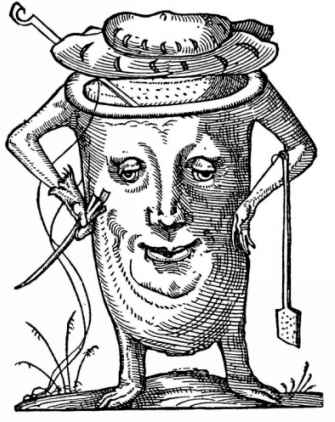
In the deserts of Libya [Africa], according to Pliny, live men with their faces on their chests; they lack head and necks and make up part of Shakespeare’s “Anthropophagi, and men whose heads/ Do grow beneath their shoulders.”
John Block Friedman, The Monstrous Races in Medieval Art and Thought (1981)
“Anthropophagi” means “one who eats men.” Most medieval pictures of Blemmyae look rather silly, and the idea seems to be based on the imagining of one’s breasts as huge eyes and one’s navel as a mouth. Yet the headless creatures were known to the ancient inhabitants of Mexico as well, and these are described in a frightful fashion.
According to Montague Summers’ The Vampire: His Kith and Kin (1928), the Aztec god Tezcatlipoca sometimes manifested himself as a Blemmye-like horror, which was called Youaltepuztli, which means “ax of the night.” Sometimes at night a noise might be heard like someone chopping on a tree with an ax:
Should anyone dare to investigate the cause of the noise he was suddenly caught by Tezcatlipoca who appeared as a decomposing headless corpse in whose mouldering breast were set “two little doors meeting in the centre [the rib cage?],” and it was the swift opening and shutting of these which produced the sound of a man hewing down the trees. [p. 261]
Thus the Blemmye may be some species of undead, but, like vampires and ghouls, it must feed on humanity, its chest cavity somehow transformed into a mouth.
I think the voodoo dances, the loa, the idea that vampires cannot enter a house without an invitation, and other detritus are the natural superstitions that arise to “explain” the unknown [wrote Langley]. They are hogwash -- yet there is something, an Essence that flows like oil into bodies after the life-force has left, a Substance that might have intelligence and desires of its own, or that follows the old neural pathways and adapts dead memories as its own: Something that uses the empty vessels of the Dead as its arms and legs and eyes. And this fluid, this non-life that imitates life, pools down into the murky waters of Schuster’s Marsh. Do not leave the Dead in Schuster’s Marsh.
-- Untitled fragment
Ambulons are animated corpses of humans and other creatures controlled by an unknown intelligence. They are not individual beings, but small parts of a single entity, like the bees of a hive. Even destroying every last Ambulon will not stop the guiding essence; it must be attacked psychically or magically, or its place of pooling (marsh, cave, graveyard, etc.) must be drained or filled.
Comments: Chester: Here are zombie-type beings that could be quasi-science-fiction as much as fantasy or horror.
M: Again, I have to say the barriers between fantasy and SF are not as obvious in my stories. I mean, there are the sub-genres of urban fantasy, and magical realism -- fantasies set in "our" world would collide eventually with our technology and scientific mind-set, I would think. And "Ambulon" comes from the Latin "to walk". I just recently noticed that one definition of "walk" in any dictionary is for the dead to rise and wander (though that refers to a spirit).
C: And, off-topic, hopefully we'll catch up to the present with our weekly monsters soon!
Back to The Fantasy World Project
Send us your comments about our cute little Monsters!